
AI Remote Control Lighting Service is transforming how people manage lighting in residential, commercial, hospitality and office environments. Modern lighting systems are no longer limited to traditional switches and manual adjustments. With intelligent automation, remote access and adaptive lighting controls, businesses and property owners can manage lighting according to their needs, schedules and preferences.
From creating comfortable living spaces to improving lighting management in hotels, offices and commercial buildings, AI-powered lighting technology offers a flexible approach to modern illumination. These solutions can help simplify daily operations, support energy-efficient practices and create customised lighting experiences for different environments.
In this guide, we explore how AI remote control lighting works, its key benefits and how intelligent lighting automation can enhance different types of spaces.
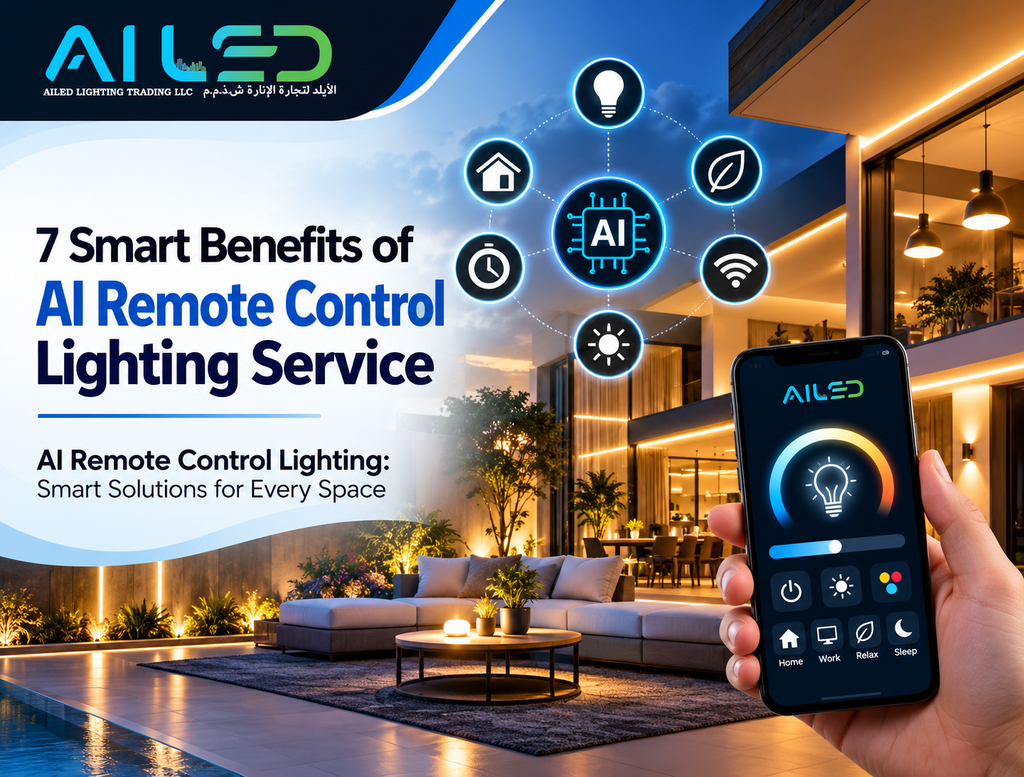
Smart Lighting Solutions by AILED
AILED Lighting Trading LLC provides lighting solutions designed to meet the needs of modern residential, office, hotel and commercial spaces. With a focus on façade, architectural and landscape lighting, AILED supports projects that aim to combine functionality, visual appeal and efficient lighting design. By exploring AI Remote Control Lighting Service and Smart Lighting Control Solutions, property owners and businesses can create adaptable lighting environments that suit different activities and operational requirements. AILED aims to help clients explore modern lighting possibilities for building smarter, more comfortable and visually appealing spaces.
What Is AI Remote Control Lighting Service ?
AI remote control lighting is an users can control compatible lighting systems through mobile applications, central control panels, voice assistants or integrated building management platforms.
Depending on the system, lighting can respond to occupancy, daylight levels, programmed schedules and user preferences. AI-enabled platforms may also analyse usage patterns and recommend or automate lighting adjustments.
Unlike conventional lighting systems that require manual operation, AI-Powered Lighting Automation can make lighting management more convenient and responsive.
Common features include:
Remote lighting control through compatible devices.
Automated switching based on schedules and occupancy.
Adjustable brightness and colour temperature where supported.
Lighting scenes for different activities and occasions.
Integration with compatible sensors and building automation systems.
The exact capabilities depend on the selected technology, connected devices and system configuration.
7 Smart Benefits of AI Remote Control Lighting Service
- Convenient Remote Access
One of the biggest advantages of an AI Remote Control Lighting Service is the ability to manage lighting without operating every switch manually.
Property owners, facility managers and authorised users can control compatible lights through a mobile application or centralised platform. This is particularly useful for large properties, multi-room environments and buildings with several lighting zones.
For example, a property manager can switch off connected lights in an unused area or adjust the lighting in a meeting room without visiting the location physically.
Remote access helps simplify everyday lighting management and gives users greater control over their environments.
- Improved Energy Efficiency
Lighting can contribute significantly to a building’s electricity consumption, particularly when lights remain switched on in unoccupied areas.
Smart Lighting Control Solutions can help reduce unnecessary lighting usage through occupancy sensors, daylight-responsive controls and automated schedules. AI-enabled systems may also use historical usage patterns to optimise lighting settings where suitable.
For instance, office lights can be programmed to operate during working hours, while compatible sensors can help reduce lighting in empty rooms.
Actual energy savings depend on the existing lighting system, operating schedules, occupancy patterns and the effectiveness of the installed controls.
- Personalised Lighting Experiences
Different activities require different lighting conditions.
AI remote control lighting systems can support customised settings for brightness, colour temperature and lighting scenes when compatible fixtures are installed.
Users may create different settings for:
Reading and focused work.
Relaxation and entertainment.
Meetings and presentations.
Dining and hospitality environments.
Evening and nighttime activities.
These options make it easier to adapt a space to changing requirements without manually adjusting individual lights.
- Smarter Commercial Lighting Automation
Commercial Lighting Automation helps businesses manage lighting across offices, retail stores, showrooms, restaurants and other commercial environments.
Rather than controlling each light independently, businesses can organise lighting into zones and establish schedules based on operating hours, occupancy and business activities.
Retail stores can use different lighting scenes for product displays, customer areas and back-office spaces. Restaurants can adjust compatible lighting to create different atmospheres throughout the day.
For larger properties, centralised control can also make it easier for facility teams to manage multiple areas from a single platform.
- Better Hotel Lighting Control Systems
Hotels require lighting that supports guest comfort while allowing staff to manage rooms and shared spaces efficiently.
Hotel Lighting Control Systems can provide customised lighting scenes for guest rooms, reception areas, restaurants, conference rooms and corridors.
For example, guests may be able to select a relaxation scene, activate reading lights or adjust room brightness using compatible controls. Hotels can also configure scheduled lighting for common areas and service spaces.
When integrated with suitable hotel management and building automation platforms, lighting controls can support a more consistent guest experience.
The level of automation depends on the hotel’s infrastructure, selected products and integration requirements.
- More Flexible Office Lighting Automation
Office Lighting Automation can help create productive work environments by adapting lighting to different activities and occupancy levels.
Intelligent controls allow these zones to operate according to their individual needs.
For example, meeting rooms can use scheduled lighting scenes, while compatible daylight sensors can adjust artificial lighting based on available natural light.
Businesses can also establish different settings for normal working hours, presentations, cleaning schedules and after-hours operations.
- Convenient Residential Smart Lighting Solutions
Residential Smart Lighting Solutions allow homeowners to manage lighting according to their daily routines and preferences.
From living rooms and bedrooms to kitchens, gardens and outdoor areas, compatible lighting systems can provide flexible control through mobile applications, sensors and automation schedules.
Homeowners may configure lights to switch on at selected times, adjust brightness for different activities or control several rooms through one interface.
Some systems can also integrate with compatible smart home platforms, allowing lighting to work alongside other connected devices.
These features can make everyday lighting more convenient and help households manage lighting usage more effectively.
How AI-Powered Lighting Automation Works
AI-Powered Lighting Automationcombines connected lighting devices, control software and, where supported, intelligent decision-making capabilities.
Although system designs vary, a typical setup may include the following components.
Step 1: Connected Lighting Fixtures
Compatible LED lights, drivers, dimmers and controllers provide the physical lighting infrastructure. The selected hardware must support the intended control method.
Step 2: Sensors and Input Devices
Occupancy sensors,daylight sensors, switches and other connected devices provide information about the environment and user activity.
Step 3: Centralised Control Platform
A mobile application, controller or building management platform allows authorised users to manage lighting zones, schedules and scenes.
Step 4: Automation Rules and AI Features
The system follows configured rules to adjust lighting according to schedules, occupancy and sensor readings. AI-enabled systems may additionally analyse usage patterns or optimise settings, depending on their capabilities.
Step 5: Monitoring and Adjustment
Users can review system performance, change lighting preferences and update automation settings to meet changing requirements.
Not every smart lighting product uses artificial intelligence. Some systems rely primarily on programmed rules, sensors and remote controls. Choosing the right technology requires understanding the actual features needed for the property.
AI Remote Control Lighting Service for Different Spaces
Residential Properties
Homes can benefit from room-based lighting control, scheduled operation, adjustable brightness and integration with compatible smart home devices.
Offices and Corporate Buildings
Businesses can manage lighting zones, meeting rooms, workspaces and common areas through centralised controls and occupancy-based automation.
Hotels and Hospitality Venues
Hotels can create guest-focused lighting scenes while supporting consistent lighting schedules in reception areas, restaurants and shared facilities.
Retail Stores and Showrooms
Retail businesses can manage display lighting, highlight selected products and adapt lighting scenes for different operating periods.
Restaurants and Entertainment Spaces
Restaurants, cafés and entertainment venues can use adjustable lighting scenes to suit different activities, events and customer experiences.
Outdoor and Landscape Areas
Compatible outdoor lighting controls can support scheduled operation and automated adjustments for pathways, gardens, parking areas and building exteriors. Outdoor installations should use equipment designed for the relevant environmental conditions.
How to Choose the Right Smart Lighting Control Solutions
Selecting the right lighting automation system requires more than choosing smart bulbs or a mobile application. The system should match the property’s size, lighting design, operational requirements and future expansion plans.
Consider the following factors before selecting a solution.
- Define your requirements: Identify the areas that need remote control, scheduling, dimming, sensor-based automation or customised lighting scenes.
- Check compatibility: Confirm that existing fixtures, LED drivers, dimmers and controllers support the proposed control technology.
- Evaluate scalability: Choose a system that can accommodate additional rooms, lighting zones or connected devices if your requirements grow.
- Review integration options: Check compatibility with existing smart home systems, building management platforms or hotel automation infrastructure.
- Consider ease of use: Ensure that the control interface is practical for homeowners, employees, facility managers or hotel guests.
- Plan installation and maintenance: Review wiring requirements, network connectivity, system configuration, technical support and future servicing needs.
- Assess security: Use supported security features, strong authentication and appropriate access permissions to protect connected lighting systems.
A professional assessment can help identify the most suitable combination of lighting fixtures, controllers, sensors and automation software.
Why Professional Installation and Configuration Matter
An effective AI Remote Control Lighting Service begins with understanding the space and selecting compatible components.
Professional planning can help ensure that lighting fixtures, control devices, sensors and software work together as intended. It can also help avoid common issues such as incompatible dimmers, unreliable connectivity, poorly configured automation rules and inconvenient lighting scenes.
For offices, hotels and commercial properties, the planning process may include lighting zone design, operational schedules, integration requirements and user access permissions.
A properly configured system can make lighting management easier while providing flexibility for future changes.
The Future of AI Remote Control Lighting
Intelligent lighting technology continues to develop as connected devices, automation platforms and AI capabilities become more advanced.
Future applications may include more adaptive lighting schedules, predictive maintenance alerts, improved occupancy analysis and deeper integration with building management systems.
These capabilities can support more responsive lighting environments, particularly in large commercial buildings, hotels and multi-zone properties.
However, the benefits depend on the system’s actual capabilities, the quality of its installation and how effectively the technology is used.
For property owners and businesses planning new lighting projects, evaluating automation options early can help create a more flexible and manageable lighting infrastructure.
Conclusion
AI Remote Control Lighting Service offers a modern approach to managing lighting across homes, offices, hotels and commercial environments. Through remote access, automated schedules, sensor integration and compatible AI-powered features, these systems can improve convenience and support more efficient lighting management.
From Commercial Lighting Automation to Hotel Lighting Control Systems and Residential Smart Lighting Solutions, the right setup can be tailored to the needs of each space.
Before investing in a solution, assess your lighting requirements, device compatibility, integration needs and long-term plans. A well-designed lighting control system can help create comfortable, adaptable and easier-to-manage environments.
Looking to upgrade your lighting control system? Explore smart lighting automation options suited to your property, operational requirements and future plans.
Frequently Asked Questions (FAQs)
Q1. What is an AI Remote Control Lighting Service offered by AILED?
AILED explores modern lighting solutions that support intelligent control, automation and customised lighting experiences for residential, office, hotel and commercial spaces, depending on system compatibility and project requirements.
Q2. How can AILED help with Smart Lighting Control Solutions for commercial spaces?
AILED Lighting Trading LLC provides lighting solutions for architectural, façade and landscape projects. Smart lighting control technologies can complement these projects by enabling convenient lighting management, automated schedules and adaptable lighting settings.
Q3. Why choose AILED for AI-Powered Lighting Automation projects?
AILED offers lighting solutions for different project requirements, helping clients explore modern lighting designs for various environments. Combining suitable lighting products with compatible automation technology can support functionality, visual appeal and more efficient lighting management.