
Smart Lighting Solutions are transforming the way people experience lighting in homes, offices, hotels, and commercial buildings. Modern technology allows users to control brightness, colour, schedules, and lighting environments through intelligent systems, mobile applications, and remote-control devices.
As buildings become more connected, property owners and developers are exploring lighting technologies that offer convenience, energy efficiency, flexibility, and improved control.
With the introduction of AI Remote Control Lighting and automated lighting systems, users can create personalised lighting experiences without manually adjusting every fixture.
In Dubai and across the UAE, smart lighting technology is becoming increasingly relevant to luxury residences, hospitality developments, corporate offices, and modern architectural projects.
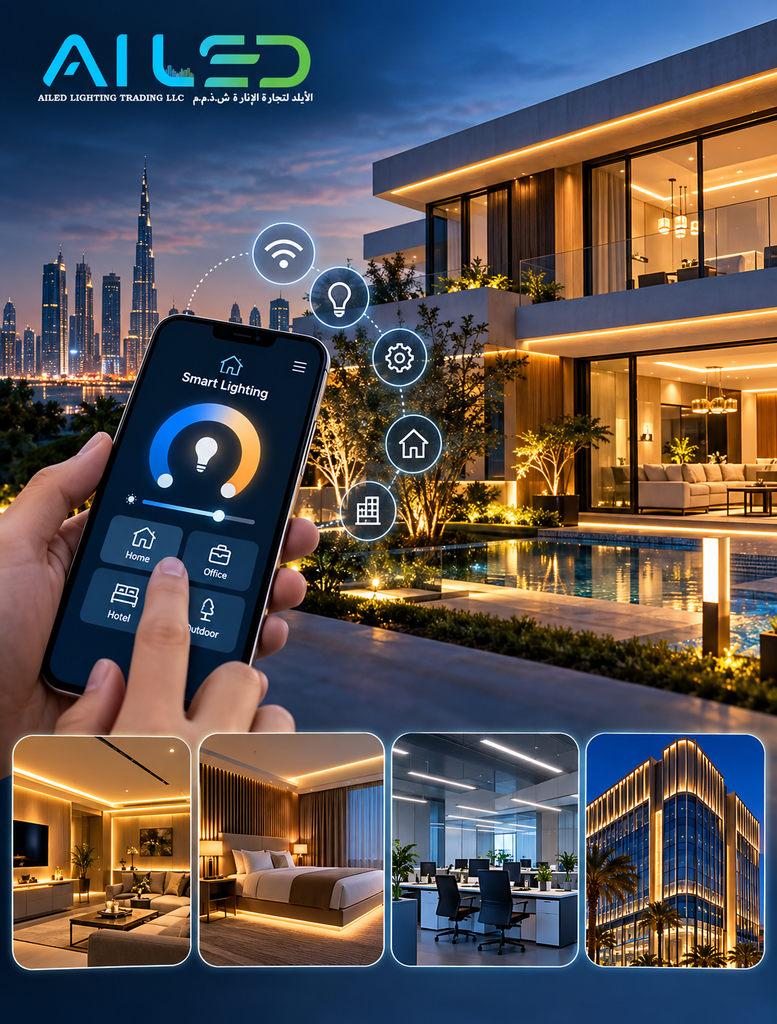
At AILED Lighting Trading LLC, architectural lighting and intelligent control technologies form part of the wider conversation around creating visually appealing, functional, and future-ready spaces.
1. What Are Smart Lighting Solutions?
Smart Lighting Solutions are advanced lighting technologies that allow users to manage lighting through digital controls, automation platforms, sensors, and connected devices.
Unlike traditional lighting installations, which rely primarily on manual switches, smart lighting systems can respond to schedules, occupancy, daylight availability, and user preferences.
A typical smart lighting installation may include:
- Smart LED lighting fixtures and compatible drivers
- Wireless or wired lighting controllers
- Motion and occupancy sensors
- Mobile application controls
- Dimming and colour adjustment features
- Automated lighting schedules
- Centralised lighting management software
These components can work together to provide a more flexible lighting environment.
For example, a homeowner can create different lighting scenes for working, relaxing, or entertaining guests.
The main objective is to deliver the right lighting conditions when and where they are needed.
2. How AI Remote Control Lighting Works
AI Remote Control Lighting combines connected lighting technology with intelligent software to simplify lighting management.
Traditional remote-controlled lighting allows users to change settings through a handheld controller or mobile application. AI-enabled systems can go further by using data, sensors, and programmed preferences to recommend or automatically adjust lighting conditions.
Intelligent brightness adjustment
Some smart lighting systems use daylight sensors to adjust artificial lighting according to available natural light.
For example, when sufficient sunlight enters a room, the system can reduce the output of compatible LED fixtures. As daylight decreases, the system can increase brightness to maintain the desired lighting level.
Automated lighting schedules
Lighting schedules allow users to define when specific fixtures should operate.
A residential lighting schedule might include soft lighting during the evening, reduced lighting late at night, and brighter lighting during morning activities.
Remote lighting access
Remote-Controlled Smart Lighting Solutions allows authorised users to manage compatible fixtures through connected applications or control platforms.
Depending on the system configuration, users may be able to adjust brightness, activate scenes, monitor status, and change schedules while away from the property.
AI-based optimisation
Advanced AI-Powered Lighting Automation platforms may analyse occupancy trends, usage patterns, or environmental conditions to optimise lighting behaviour.
However, not every smart lighting product includes genuine AI capabilities. Some products offer rule-based automation rather than adaptive machine-learning functions.
Understanding this distinction helps buyers select technology that matches their actual requirements.
3. Benefits of Smart Lighting Control Systems
Smart Lighting Control Systems offer several advantages for residential and commercial environments.
Improved energy efficiency
Actual energy savings depend on fixture efficiency, operating hours, building design, system configuration, and user behaviour.
Greater convenience
Instead of controlling multiple fixtures individually, users can operate selected lighting groups through a single interface.
This is especially useful in large homes, hotels, office buildings, and commercial properties.
Customised lighting environments
Smart lighting systems allow users to create different lighting scenes for various activities.
A living room can have a comfortable evening setting, while a conference room can use brighter lighting for meetings and presentations.
Better operational control
This simplifies scheduling, scene management, and day-to-day operation.
Flexible system expansion
When designed with compatible protocols and sufficient capacity, smart lighting systems can support future upgrades or additional control zones.
4. Residential Smart Lighting Solutions for Modern Homes
Residential Smart Lighting Solutions are becoming an important consideration in modern villas, apartments, and luxury homes.
Homeowners increasingly want lighting systems that combine convenience, design, and personalised control.
Smart living room lighting
For example, a movie scene can dim ceiling fixtures and activate decorative accent lighting, while a reading scene can provide focused illumination.
Intelligent bedroom lighting
Bedrooms benefit from adjustable brightness and colour temperature.
Warm lighting can create a relaxing evening environment, while brighter settings can support everyday activities such as dressing and cleaning.
Automated schedules can also help users establish consistent lighting routines.
Kitchen and dining automation
Kitchens require practical task lighting, while dining areas often benefit from softer decorative illumination.
Smart controls allow these lighting requirements to be managed independently or through preset scenes.
Outdoor and garden lighting
Smart lighting can also enhance balconies, pathways, gardens, and residential façades.
With suitable outdoor-rated fixtures and controllers, homeowners can schedule landscape lighting and adjust decorative effects remotely.
These features make smart lighting a useful addition to modern Home Automation Services.
5. Commercial Lighting Automation for Business Spaces
Commercial Lighting Automation helps businesses manage lighting across larger and more complex environments.
Commercial properties often contain multiple zones with different operating schedules and illumination requirements.
Retail stores and shopping centres
Retail lighting playsan important role in product presentation and customer experience.
Smart systems can adjust lighting scenes for operating hours, promotional displays, and after-hours maintenance.
Corporate buildings
Lighting levels can be adapted for meeting rooms, reception areas, corridors, and workspaces.
Restaurants and entertainment venues
Restaurants frequently require different lighting atmospheres throughout the day.
Large commercial developments
In larger properties, Intelligent Lighting Management Systems can support coordinated operation across multiple floors or zones.
This can simplify daily lighting management and provide better visibility into system operation.
6. Hotel Lighting Control Systems for Hospitality Projects
Lighting contributes significantly to the atmosphere of hotels, resorts, and luxury hospitality destinations.
Hotel LightingControl Systems allow designers and operators to create consistent lighting experiences while maintaining operational flexibility.
Guest room automation
Smart guest room lighting can offer preset scenes such as welcome,relaxation, reading, and sleep.
Where compatible systems are installed, lighting may also integrate with room occupancy or hotel management functions.
Lobby and reception lighting
Hotel lobbies are often designed to create a memorable first impression.
Automated lighting scenes can help maintain a suitable atmosphere throughout the day and evening.
Corridors and shared spaces
Occupancy-responsive lighting can reduce unnecessary operation in suitable low-traffic areas, while maintaining required safety and emergency illumination.
Event halls and conference facilities
Hotels frequently host meetings, celebrations, and business events.
Programmable lighting scenes can support different event formats and reduce the time required to prepare the space.
For hospitality developments in Dubai, lighting automation should be considered early in the design process to ensure compatibility with architectural, interior, and operational requirements.
7. Office Lighting Automation and Intelligent Workspaces
Office Lighting Automation is an important element of modern workplace design.
Different office areas require different lighting conditions. Open workstations, meeting rooms, private cabins, reception spaces, and collaborative zones may all have separate requirements.
Intelligent lighting controls allow these areas to be managed according to their functions.
Occupancy-based lighting
Sensors can detect whether designated spaces are occupied and communicate with the lighting control system.
When an area becomes vacant, the system may dim or switch off nonessential lighting according to its programmed settings.
Daylight-responsive control
Workspaces near windows may receive sufficient natural illumination during certain hours.
Daylight-responsive lighting can reduce artificial light output while maintaining suitable working conditions.
Personalised lighting settings
In compatible installations, employees may have access to local dimming controls or preset scenes.
This can improve flexibility for different tasks and individual preferences.
Centralised management
Facility managers can manage lighting schedules and operating modes across different office zones.
The DALI Alliance documents how connected lighting systems use occupancy and daylight sensors, programmable controls, and lighting scenes in modern workplaces.
Digital Illumination Interface Alliance
+1
8. AI-Powered Lighting Automation vs Traditional Lighting
Traditional lighting systems and intelligent lighting technologies differ in how they respond to user requirements.
| Feature | Traditional Lighting | Smart Lighting |
|---|---|---|
| Control | Manual switches | Apps, switches and controllers |
| Brightness | Fixed or basic dimming | Programmable dimming |
| Scheduling | Limited | Automated schedules |
| Sensors | Usually separate | Integrated when supported |
| Remote access | Generally unavailable | Available in connected systems |
| Energy management | Manual operation | Occupancy and daylight controls |
| Personalisation | Limited | Custom lighting scenes |
The greatest advantage of smart lighting is not simply remote operation. It is the ability to coordinate lighting with how a space is actually used.
Advanced AI-Powered Lighting Automation can extend these capabilities through adaptive optimisation and data-driven control.
However, the appropriate solution depends on the size, purpose, budget, and technical requirements of each project.
9. Integrating Smart Lighting with Façade and Architectural Lighting
Smart lighting technology is not limited to interior spaces.
Architectural lighting projects can also benefit from intelligent controls, particularly when buildings require dynamic colour effects, coordinated illumination, or scheduled nighttime presentation.
A modern commercial building may include architectural façade lighting, landscape lighting, entrance lighting, and decorative outdoor fixtures.
When compatible systems are integrated correctly, these elements can be managed through coordinated control strategies.
Dynamic façade lighting
Programmable controllers can manage colour-changing LED fixtures to create lighting sequences for architectural façades.
DMX-based control systems are commonly used for installations requiring coordinated dynamic effects.
Automated exterior lighting
Exterior fixtures can operate according to programmed schedules or suitable environmental sensors.
This helps building operators manage nighttime illumination without relying entirely on manual switching.
Architectural lighting scenes
Different lighting scenes can be designed for regular evenings, special events, and seasonal occasions.
The selected effects should complement the building’s architecture rather than overwhelm its visual character.
Centralised lighting coordination
Large developments may require separate lighting control networks for interior, exterior, and decorative lighting.
Appropriate gateways and integration platforms can support coordination where technically compatible.
For developers researching an ailed facade lighting company, AILED Lighting Trading LLC represents a Dubai-based architectural lighting business to consider when exploring façade, exterior, and intelligent lighting requirements.
The selection of control technology should always follow the project’s lighting design, fixture specifications, and integration needs.
10. How Smart Lighting Solutions Support Energy Efficiency
Energy efficiency is one of the most practical reasons to consider Smart Lighting Solutions.
In conventional installations, lights may remain at full brightness even when a space is empty or sufficient daylight is available.
Intelligent lighting controls can address these situations through automated operation.
Occupancy detection
Occupancy sensors help reduce unnecessary lighting operation in areas such as meeting rooms, corridors, storage rooms, and selected shared spaces.
Daylight harvesting
Daylight harvesting systems measure available natural light and adjust compatible artificial lighting accordingly.
Scheduled operation
Automated schedules help ensure lighting operates according to building usage rather than remaining continuously active.
Lighting level optimisation
Dimming controls allow lighting output to be adjusted to the actual requirements of a space.
The U.S. Department of Energy identifies occupancy sensing, daylight dimming, and appropriate lighting controls as strategies for reducing lighting energy consumption.
Importantly, smart lighting does not guarantee a specific percentage of energy savings. Performance depends on the installation, existing lighting equipment, operating patterns, and control settings.
11. Choosing the Right Smart Lighting Control System
Selecting the right lighting control system requires more than comparing product features.
Building owners, architects, and consultants should evaluate the following considerations before installation.
- Project requirements: Identify the lighting functions required for each area, including dimming, scheduling, colour control, and automation.
- System compatibility: Confirm that fixtures, drivers, sensors, and controllers support the selected control protocols.
- Wired or wireless operation: Evaluate the advantages and limitations of each approach based on building size, construction conditions, and maintenance needs.
- User interface: Choose a control platform that is practical for homeowners, staff, or facility managers.
- Security and reliability: Consider network security, access permissions, software support, and local control availability during connectivity interruptions.
- Future expansion: Plan for additional lighting zones, upgrades, and potential integration with other building systems.
Technologies such as DALI-2 provide standardised digital lighting-control capabilities, including support for compatible control gear, sensors, and user-input devices.
Digital Illumination Interface Alliance
Professional planning helps ensure that the chosen system is suitable for the building rather than simply offering the largest number of features.
12. The Future of Intelligent Lighting Management Systems in Dubai
As buildings become more connected, Intelligent Lighting Management Systems are likely to play a greater role in architectural and property development.
The future of smart lighting involves closer coordination between lighting design, building automation, digital control platforms, and energy management.
Potential developments include more adaptive lighting schedules, improved system diagnostics, expanded interoperability, and more sophisticated occupancy-responsive control.
For Dubai’s residential, hospitality, and commercial sectors, these technologies create opportunities to combine modern architectural design with practical building management.
However, successful implementation requires careful attention to lighting quality, fixture compatibility, user experience, and long-term maintenance.
The objective should not be automation for its own sake. It should be a lighting environment that is easier to manage, appropriate for its occupants, and visually aligned with the architecture.
13. AILED Lighting Trading LLC and Smart Architectural Lighting
AILED Lighting Trading LLC is associated with architectural, façade, exterior, and lighting control solutions in Dubai and the UAE.
For projects considering Smart Lighting Solutions, the relationship between lighting equipment and control technology is an important part of the design process.
Architects, consultants, property developers, and building owners should consider how lighting fixtures will operate together, how different lighting zones will be controlled, and whether the proposed system supports future operational needs.
Combining architectural lighting design with appropriate automation planning can help create spaces that are visually distinctive and practical to manage.
For more information about AILED’s lighting solutions and project requirements, visit AILED Lighting Trading LLC .
Conclusion: Why Smart Lighting Solutions Matter
Smart Lighting Solutions are changing the relationship between people, buildings, and illumination.
From Residential Smart Lighting Solutions and Home Automation Services to Commercial Lighting Automation and Hotel Lighting Control Systems, intelligent lighting technology offers new ways to manage brightness, scheduling, atmosphere, and energy consumption.
AI Remote Control Lighting and advanced automation platforms can provide additional flexibility, particularly when systems are designed around actual building requirements.
For modern developments in Dubai and the UAE, smart lighting should be viewed as part of a wider architectural and operational strategy.
AILED Lighting Trading LLC highlights the importance of combining architectural lighting requirements with suitable control technologies to create functional and visually engaging spaces.
Frequently Asked Questions (FAQs)
1. What are Smart Lighting Solutions?
Smart Lighting Solutions use connected controls, sensors, and automation to manage lighting brightness, schedules, and operating modes.
2. How does AI Remote Control Lighting work?
AI Remote Control Lighting can combine digital controls with intelligent software to adjust lighting based on preferences, sensor data, or usage patterns.
3. Can smart lighting reduce electricity consumption?
Yes. Properly configured occupancy sensors, dimming, and daylight controls can reduce unnecessary lighting energy use.
4. Are Smart Lighting Control Systems suitable for villas?
Yes. Compatible systems can manage living rooms, bedrooms, kitchens, gardens, and outdoor lighting.
5. What are the benefits of Hotel Lighting Control Systems?
They allow hotels to manage guest room scenes, public-area lighting, schedules, and selected automated functions.
6. Can smart lighting be integrated with façade lighting?
Yes. Compatible architectural lighting fixtures and controllers can support scheduled operation, colour changes, and coordinated lighting effects.
7. Is AI-Powered Lighting Automation different from basic automation?
Yes. Basic automation follows predefined rules, while AI-powered systems may use data analysis and adaptive algorithms to optimise lighting behaviour.