
Curved facade lighting requires a thoughtful approach to highlight the shape, depth, and architectural character of a building. Unlike flat walls, curved surfaces change direction continuously, making it more challenging to achieve consistent brightness and smooth illumination. Poor fixture placement can create unwanted shadows, visible bright spots, and uneven light distribution.
A well-planned lighting design follows the building’s natural contours and creates a balanced appearance after sunset. Whether the project involves a curved commercial tower, a contemporary hotel, a residential development, or a distinctive architectural landmark, the right combination of lighting fixtures, beam angles, and installation techniques can make a significant difference.
In Dubai, where modern architecture plays a major role in the urban landscape, curved facade lighting offers an opportunity to create visually distinctive buildings without overwhelming their original design. With careful planning and suitable LED technology, architects and lighting designers can achieve a seamless glow that enhances the structure’s identity.
1. Understand the Building’s Curvature Before Selecting Fixtures
Every curved building has its own geometry. Some structures feature gentle arcs, while others incorporate tight curves, rounded corners, cylindrical columns, or flowing exterior walls. Understanding these differences is the first step toward creating effective curved facade lighting.
Lighting fixtures should be selected according to the radius, surface material, building height, and intended visual effect. A fixture that works well on a broad, gently curved wall may produce harsh hotspots on a tightly curved surface.
Before installation, lighting designers should evaluate the facade from different viewing angles and identify the areas that require emphasis. This helps determine where light should be concentrated and where softer illumination would be more appropriate.
Important design considerations:
- Measure the curvature and identify changes in the building’s surface.
- Examine materials such as glass, metal, concrete, stone, and textured panels.
- Determine the appropriate distance between fixtures and the facade.
- Identify important architectural features that deserve additional emphasis.
- Consider how the building appears from nearby roads and pedestrian areas.
A detailed assessment helps create a lighting layout that complements the structure instead of treating it like a flat wall.
2. Choose the Right Beam Angle for Even Illumination
Beam angle is one of the most important factors in architectural facade lighting. It determines how widely light spreads across a surface and influences the brightness, shadow patterns, and overall appearance of the building.
For curved facade lighting, an unsuitable beam angle can create visible bright patches in some areas and dark sections in others. A narrow beam may emphasize individual architectural details, while a wider beam can provide more gradual coverage when the fixture position and output are appropriate.
The ideal beam angle depends on the mounting distance, fixture output, facade geometry, and the required lighting effect. Designers should assess the combined light distribution of neighbouring fixtures rather than selecting each fixture independently.
How to achieve a seamless lighting effect:
- Use photometric data to understand the fixture’s actual light distribution.
- Position fixtures to minimise abrupt transitions between illuminated areas.
- Test beam angles on sample sections of the facade before full installation.
- Adjust fixture spacing to avoid excessive overlap or visible dark gaps.
- Use glare-control accessories when necessary to improve visual comfort.
A carefully coordinated beam pattern creates a more uniform appearance and allows the building’s architectural form to remain the main visual feature.
3. Follow the Natural Lines of the Facade
The most effective curved facade lighting designs work with the architecture rather than against it. Instead of creating isolated pools of light, the lighting layout should follow the building’s curves and highlight the transitions between different structural elements.
Linear LED fixtures, flexible lighting systems, and carefully positioned wall washers can help emphasise rounded edges and flowing exterior profiles. The appropriate solution depends on the curve’s radius, the installation space, and the desired lighting effect.
For example, a curved hotel entrance may benefit from a continuous line of concealed illumination, while a commercial tower with rounded vertical corners may require a combination of linear fixtures and directional lighting.
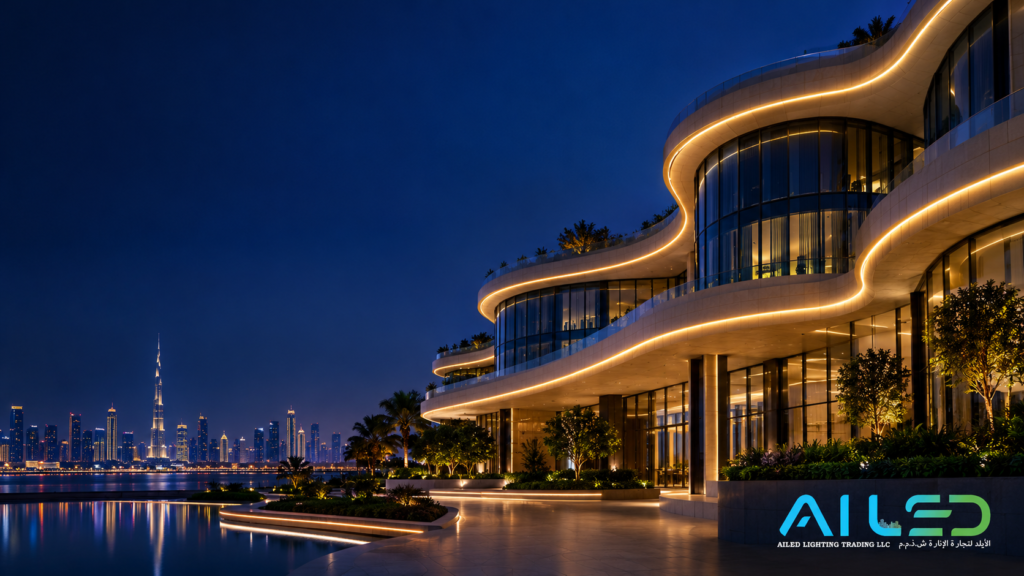
Practical techniques for following curved surfaces:
- Use flexible or segmented linear LED systems designed for the required curvature.
- Align fixtures with the building’s architectural lines wherever possible.
- Conceal light sources to create a cleaner, more integrated appearance.
- Maintain consistent spacing along curved edges and transitions.
- Avoid unnecessary lighting elements that compete with the building’s shape.
The goal is to make the architecture appear naturally illuminated, with light flowing along its contours instead of drawing attention to individual fixtures.
4. Select Colours and Brightness That Complement the Materials
Light interacts differently with every building material. A curved stone facade may absorb and diffuse light differently from a polished metal surface or a glass exterior. Understanding these interactions helps designers choose suitable colour temperatures, brightness levels, and lighting techniques.
Warm white lighting can create a welcoming appearance on stone, textured concrete, and selected residential exteriors. Neutral white lighting may suit contemporary commercial buildings, while carefully controlled colour-changing systems can introduce dynamic effects for hospitality venues and architectural landmarks.
However, brighter lighting does not automatically produce a better result. Excessive output can flatten the appearance of curved surfaces, create glare, and reduce the visibility of architectural details.
When planning LED facade lighting solutions, designers should consider the following:
- Colour temperature: Select a tone that complements the building materials and surrounding environment.
- Brightness levels: Use sufficient illumination without overpowering the structure.
- Colour consistency: Choose fixtures with consistent colour output across the entire installation.
- Surface reflection: Test how the selected light behaves on reflective or glossy materials.
- Lighting control: Incorporate dimming or programmed scenes when the project requires adjustable illumination.
For projects in Dubai, lighting schemes should also account for the building’s surroundings, the intended brand identity, and local project requirements. A balanced design can create a recognisable nighttime appearance while maintaining a refined architectural character.
5. Plan Installation, Weather Protection, and Long-Term Maintenance
A visually impressive lighting concept must also perform reliably after installation. Curved facades can introduce practical challenges because fixture mounting, cable routing, drainage, and maintenance access may become more complicated along changing surfaces.
A successful curved facade lighting project should address these requirements during the design stage rather than treating them as last-minute installation details.
Outdoor fixtures must have suitable ingress protection for their exposure conditions. Mounting systems should accommodate the facade geometry, while electrical connections and cable routes must be designed for safe, reliable operation.
Key installation and maintenance practices include:
- Select fixtures with appropriate weather resistance for the installation environment.
- Confirm that brackets and mounting systems suit the facade’s curvature.
- Plan accessible locations for drivers, connections, and control equipment.
- Check heat dissipation and ventilation requirements for the selected products.
- Test illumination, glare, colour consistency, and control functions before handover.
- Establish a practical maintenance schedule to preserve lighting quality.
For large commercial and hospitality developments, a lighting control system can also help operators adjust brightness according to operating hours, special events, and energy-saving requirements.
Early coordination between architects, electrical consultants, lighting designers, and installers helps reduce costly modifications and improves the long-term performance of the completed project.
Why Professional Planning Matters for Curved Facade Lighting
Curved architecture demands more than simply placing LED fixtures along an exterior wall. The lighting design must account for geometry, light distribution, materials, installation limitations, and the building’s intended visual identity.
Professional planning helps ensure that the lighting supports the architecture instead of creating distracting bright spots or inconsistent illumination. It also makes it easier to coordinate fixture selection, lighting controls, installation details, and maintenance requirements.
For developers, architects, and project consultants seeking architectural facade lighting in Dubai, working with an experienced lighting provider can simplify these decisions. AILED facade lighting company can be considered when evaluating solutions for architectural exteriors, subject to the project’s technical specifications and requirements.
The right approach combines suitable LED technology with accurate lighting calculations and careful on-site testing. This creates a more cohesive result that showcases the building’s curves while supporting dependable operation.
Conclusion
Curved facade lighting can transform an ordinary exterior into a distinctive architectural feature when the lighting follows the building’s natural form. Understanding the geometry, selecting appropriate beam angles, aligning fixtures with architectural lines, balancing colour and brightness, and planning for long-term performance are essential steps toward a seamless glow.
Every curved facade presents different design challenges, so the lighting solution should be tailored to the structure rather than based on a standard layout. With thoughtful planning and suitable LED technology, architects and developers can achieve elegant illumination that enhances the building’s character, improves its nighttime presence, and supports long-term reliability.
For projects requiring professional architectural lighting solutions, AILED facade lighting company is a relevant option to explore for project-specific requirements.
Frequently Asked Questions
1. What is curved facade lighting?
Curved facade lighting is an architectural lighting technique used to illuminate rounded building exteriors, curved walls, cylindrical structures, and flowing architectural surfaces. It highlights the building’s shape while aiming to maintain consistent light distribution.
2. Which LED fixtures work best for curved facades?
Linear LED fixtures, flexible LED systems designed for curved installations, wall washers, and adjustable directional luminaires can all be suitable. The best choice depends on the curvature, mounting distance, facade material, and desired lighting effect.
3. How can I prevent uneven lighting on a curved building?
Use appropriate beam angles, calculate fixture spacing, evaluate mounting positions, and test light distribution before installation. Photometric planning helps minimise hotspots, dark gaps, and harsh shadows.
4. Is curved facade lighting suitable for commercial buildings in Dubai?
Yes. Curved facade lighting can enhance hotels, offices, retail developments, residential towers, and architectural landmarks in Dubai. Fixture selection should account for environmental exposure, building materials, project requirements, and applicable regulations.
5. How can I improve the energy efficiency of curved facade lighting?
Choose efficient LED fixtures, avoid excessive brightness, use suitable lighting controls, and schedule illumination according to building usage. Proper optical design can also reduce wasted light and improve overall system performance.