
Intruduction
DMX lighting system technology can completely transform how a building looks after sunset. While static lights can highlight walls, entrances, and architectural features, dynamic lighting takes the experience much further. Colours can change smoothly, patterns can move across a façade, and different lighting scenes can be activated for events, celebrations, or everyday use. This makes DMX an effective solution for creating engaging and programmable architectural lighting effects.
This is where a DMX lighting system becomes valuable.
DMX technology gives lighting designers detailed control over compatible LED fixtures. Instead of switching lights on and off or keeping them at one fixed colour, a programmed system can control brightness, colour, timing, transitions, and lighting sequences.
For modern architectural projects, this creates opportunities to make buildings more visually engaging while keeping lighting organised and programmable.
What Is DMX Lighting?
DMX is a digital communication protocol used to control lighting equipment. It was originally developed for entertainment lighting but has become widely useful in architectural and exterior lighting applications.
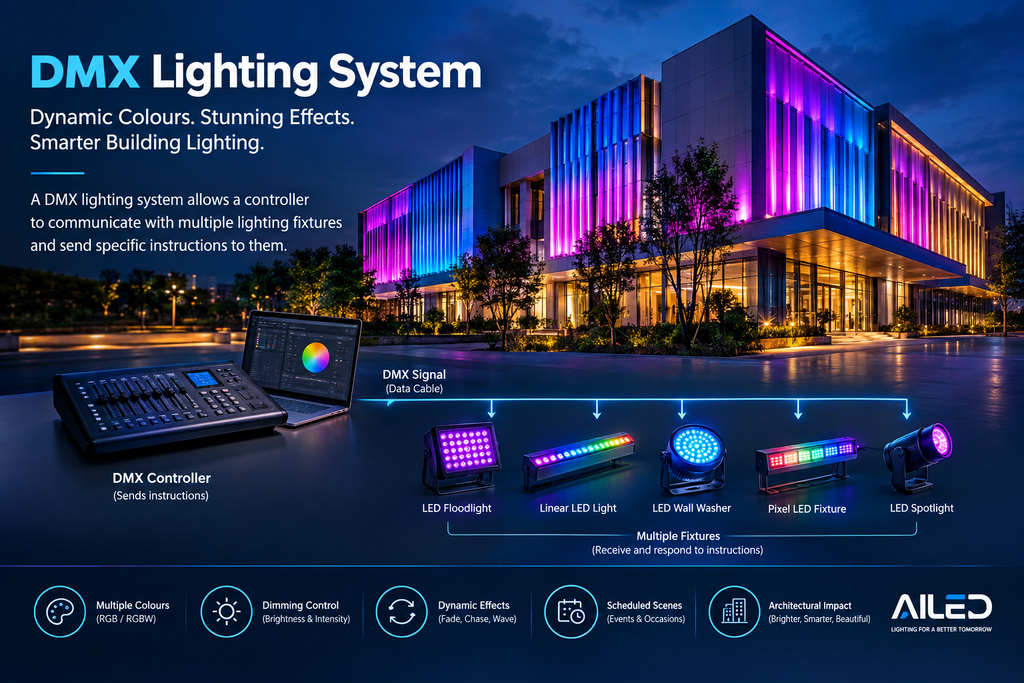
DMX lighting system allows a controller to communicate with multiple lighting fixtures and send specific instructions to them.
Depending on the fixture and setup, these instructions can control:
Light intensity
RGB colours
RGBW colours
Dimming levels
Colour transitions
Lighting sequences
Chasing effects
Timing
Individual fixture behaviour
This level of control makes DMX suitable for buildings where lighting needs to change throughout the evening or during special events.
How Does a DMX Lighting System Create Dynamic Effects?
The basic concept is straightforward.
A DMX controller sends information through the lighting network. Each compatible fixture receives the relevant instructions and responds accordingly.
For example, imagine ten LED fixtures installed along the front of a commercial building.
With a basic lighting setup, all ten fixtures might simply remain on.
With DMX control, the first fixture could turn blue, followed by the second, third, and fourth. The colour could then travel across the façade before gradually changing to another colour.
The fixtures have not physically moved.
The programmed lighting sequence creates the appearance of movement.
This is one reason DMX architectural lighting is popular for buildings that need a more dynamic nighttime appearance.
What Makes DMX Different From Normal LED Lighting?
LED technology and DMX lighting system control are not the same thing.
LED describes the lighting technology used to produce light, while DMX provides a method of controlling compatible lighting equipment.
An LED fixture can provide illumination, but when that fixture is DMX-compatible, it can become part of a much more sophisticated lighting system.
For example:
Standard LED:
One colour → Fixed brightness → Simple operation
DMX-controlled LED:
Multiple colours → Programmable brightness → Timed scenes → Dynamic effects
This distinction is important when planning architectural lighting because the fixture and control system need to be selected together.
Creating Moving Colours Across a Building
One of the most attractive applications of a DMX lighting system is creating colour movement across a façade.
A lighting designer can program fixtures so that colours appear to travel from one architectural section to another.
Some common effects include:
Colour Waves
Colours gradually move across a façade in a smooth wave-like sequence.
Colour Chasing
Individual fixtures or sections turn on and change colour one after another.
Gradual Transitions
One colour slowly fades into another instead of changing suddenly.
Pulsing Effects
Brightness increases and decreases according to a programmed rhythm.
Sequential Lighting
Different parts of a building are illuminated in a specific order.
These effects can be subtle and elegant or highly energetic, depending on the building and its purpose.
DMX Pixel Lighting: More Control, More Possibilities
For projects that require detailed visual patterns, DMX pixel lighting can provide another level of control.
Instead of controlling an entire fixture as one lighting point, pixel-based systems can allow individual sections or pixels to be controlled separately.
This makes it possible to create:
Moving gradients
Animated patterns
Waves
Colour trails
Sequential effects
Geometric patterns
Custom lighting animations
Pixel lighting can be particularly useful for large façades, entertainment spaces, commercial properties, and architectural features where lighting itself is intended to become part of the visual design.
Where Can DMX Lighting Be Used?
A DMX lighting system is not limited to entertainment venues.
It can be incorporated into many architectural environments, including:
Commercial Buildings
Businesses can use dynamic façade lighting to create a distinctive appearance after dark.
Hotels and Resorts
Hotels can create different lighting scenes for entrances, outdoor areas, events, and special occasions.
Shopping Centres
Dynamic lighting can help create an attractive exterior environment and support seasonal campaigns.
Residential Towers
High-rise buildings can use carefully programmed lighting to highlight architectural lines and features.
Restaurants and Entertainment Spaces
Colour-changing lighting can contribute to the atmosphere and visual identity of the property.
Public and Landmark Structures
Large structures can use programmed lighting sequences for celebrations, cultural events, and architectural displays.
How AILED Can Be Part of a Dynamic Lighting Project
A successful lighting project requires more than simply installing colour-changing fixtures.
At AILED, the focus can be placed on selecting suitable architectural lighting solutions based on the building’s structure, visual requirements, and operating environment.
A DMX-based project may involve several connected elements, including:
DMX controllers
RGB or RGBW LED fixtures
Linear lighting
Wall washers
Pixel LED systems
Façade lighting
Control networks
Lighting programming
The final appearance depends on how these elements are planned and coordinated.
The objective should be to make the lighting work with the architecture rather than simply adding colour to the building.
DMX Façade Lighting and Architectural Design
The façade is often the most visible part of a building at night.
Poorly positioned lights can create unwanted glare, uneven brightness, or excessive visual noise. A well-planned DMX façade lighting design can instead focus attention on important architectural elements.
For example, lighting can be used to highlight:
Vertical architectural lines
Columns
Building edges
Entrance areas
Roof features
Decorative structures
Recessed sections
Textured surfaces
The lighting sequence can then be programmed around these elements.
This creates a more structured nighttime appearance.
Can One Building Have Multiple Lighting Themes?
Yes.
One of the practical benefitsof programmable lighting is that the same installation can support different scenes.
For example:
Daily Mode:
A simple white or warm-white architectural appearance.
Evening Mode:
A softer colour-changing sequence.
Event Mode:
Brighter dynamic effects for a special occasion.
Festival Mode:
Specific colours and patterns related to a celebration.
Corporate Mode:
Brand colours incorporated into selected building elements.
This flexibility means the lighting system does not have to look exactly the same every night.
Does Dynamic Lighting Always Mean Bright Lighting?
No.
Dynamic lighting is about control and movement, not simply brightness.
A sophisticated lighting design can use low-intensity transitions and subtle colour changes while still creating a noticeable effect.
For many architectural projects, controlled lighting can be more effective than excessive brightness.
The design should consider:
Surrounding buildings
Pedestrian areas
Road visibility
Viewing distance
Architectural materials
Glare
Light spill
Operating hours
This helps maintain a balanced nighttime environment.
Planning a DMX lighting system
Before installing a DMX lighting system, several technical and design factors should be considered.
- Identify the Lighting Objective
Is the purpose architectural highlighting, branding, entertainment, event lighting, or a combination?
- Map the Building
The façade should be studied to identify suitable positions for fixtures and control equipment.
- Choose Compatible Fixtures
RGB, RGBW, pixel, linear, and floodlighting fixtures can have different control requirements.
- Plan the Control Network
The DMX communication system should be planned according to the number and arrangement of fixtures.
- Create Lighting Scenes
Programming should be based on how the building will actually be used.
- Consider Maintenance
Outdoor fixtures, cables, controllers, and other components need suitable access for maintenance.
- Plan Operating Schedules
Automated schedules can help ensure that lighting operates only when required.
DMX Lighting System and Energy Efficiency
Dynamic lighting does not automatically mean high energy consumption.
Energy use depends on the fixtures selected, operating duration, brightness levels, number of fixtures, and programmed scenes.
A carefully designed system can use:
Appropriate fixture wattage
Scheduled operation
Dimming
Selective lighting
Automated switching
Efficient LED technology
Instead of illuminating every part of a building at maximum brightness throughout the night, the system can use different intensity levels depending on the time and purpose.
Why Professional Programming Matters
Installing DMX-compatible fixtures is only one part of the project.
The final visual quality depends heavily on programming.
Poor programming can make a façade appear too fast, distracting, or inconsistent. Professional programming can create smoother transitions and better coordination between different architectural elements.
The lighting sequence should support the building rather than overpower it.
For this reason, lighting design, fixture selection, control planning, installation, and programming should ideally be considered as one complete process.
The Future of Architectural Lighting
Modern buildings increasingly use lighting as part of their identity.
Architectural lighting is moving beyond the idea of simply making a structure visible at night. Designers can now use programmable technologies to create changing visual experiences while maintaining control over the entire installation.
A DMX lighting system can become an important part of this approach by connecting multiple lighting fixtures into one coordinated system.
Combined with RGBW LEDs, pixel lighting, smart controls, automation, and façade lighting, DMX technology provides flexibility for a wide range of modern projects.
Conclusion
A building does not have to remain visually static after sunset.
With a properly designed DMX lighting system, architectural lighting can change colour, transition between scenes, create movement, and respond to different events or schedules.
From commercial buildings and hotels to residential towers and large architectural structures, DMX technology provides a practical way to manage dynamic lighting effects.
The key is not simply adding more colours or more lights. Effective lighting comes from understanding the architecture, selecting suitable fixtures, planning the control system, and programming effects that complement the building.
With solutions from AILED, dynamic architectural lighting can be planned around the project’s design, functionality, and nighttime visual requirements.
When technology meets thoughtful design, lighting can turn a building from a structure into a memorable nighttime experience.