
Introduction
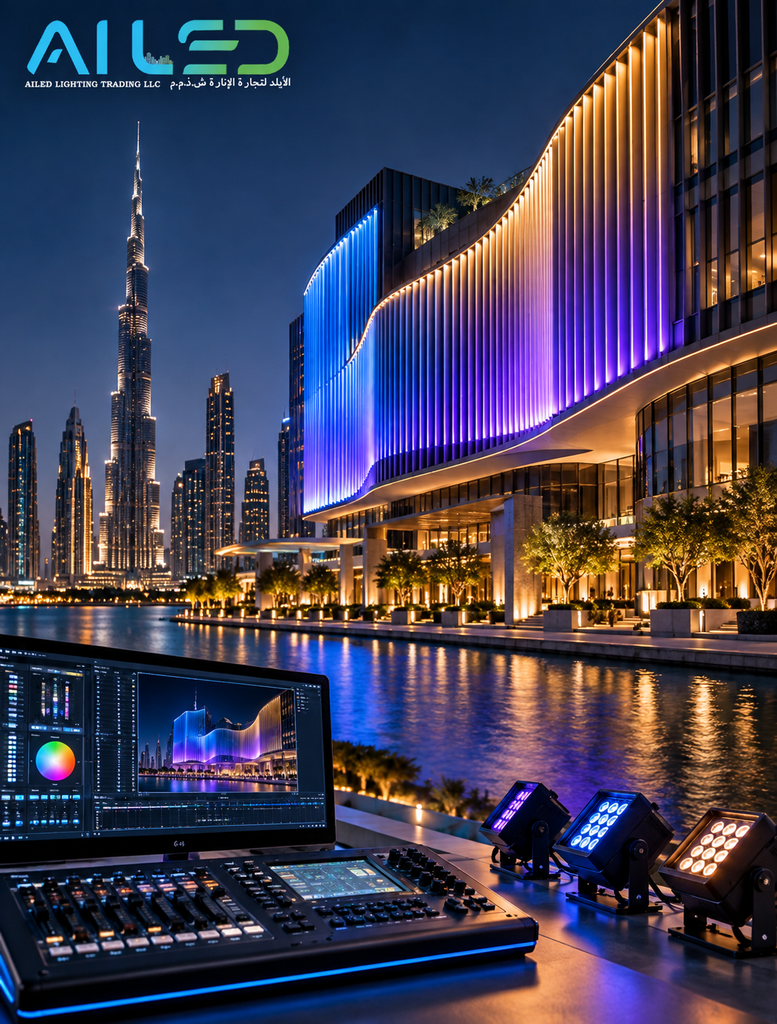
DMX Lighting Control : Imagine a large building in Dubai illuminated by more than 500 LED fixtures.
Individually, every fixture may be powerful, efficient, and capable of producing impressive colours. But architectural lighting is not about making hundreds of separate lights turn on. The real challenge is making every fixture respond at the right moment, at the right intensity, and with the right colour.
That is where DMX lighting control becomes essential.
For large-scale façade and architectural lighting projects, a properly designed control system can transform hundreds of individual LED fixtures into one coordinated lighting installation. Instead of behaving like separate products installed across a building, the fixtures can operate as one visual system.
At AILED Lighting Trading LLC, lighting control is considered an important part of creating dynamic and coordinated architectural lighting solutions for projects in Dubai and the UAE.
What Is DMX Lighting Control?
DMX, or DMX512, is a digital communication protocol widely used to control entertainment and architectural lighting.
A dmx lighting control universe can carry up to 512 individual control channels. Each channel carries a value between 0 and 255, which can be used to control parameters such as brightness, colour, movement, or other functions supported by a fixture.
For example, an RGBW fixture may require separate channels for red, green, blue, and white. When hundreds of these fixtures are individually controlled, the total channel requirement can quickly exceed the capacity of a single dmx lighting control universe.
This is why large projects require careful planning of addresses, universes, controllers, network infrastructure, and fixture groups.
Why Controlling 500+ LED Fixtures Is More Complicated Than It Looks
A façade containing 500 fixtures is not simply a larger version of a 20-fixture installation.
The scale changes the control requirements.
Every controllable fixture needs to receive the correct information. When several fixtures are supposed to change colour simultaneously, they should appear visually coordinated. When an animation moves from one side of a building to another, its sequence needs to follow the architectural layout accurately.
Poor control planning can result in problems such as:
Incorrect fixture addressing
Unwanted colour differences
Fixtures responding at the wrong time
Flickering or unstable behaviour
Incorrect zoning
Communication problems
Difficult troubleshooting and maintenance
Effective DMX lighting control starts long before the final programming stage.
How Does DMX Make Hundreds of Fixtures Work Together?
Think of the control system as the communication layer between the lighting designer’s concept and the installed LED fixtures.
Each controllable fixture is assigned an address or position within the control architecture. The controller then sends instructions that determine how those fixtures should behave.
With the correct programming, 500+ fixtures can be divided into logical groups and zones or controlled individually where the project requires it.
This allows designers to create effects such as synchronized colour changes, smooth dimming sequences, gradients across a façade, animated patterns, programmed scenes, event-specific themes, and coordinated building-wide transitions.
The result is not 500 lights doing 500 unrelated things.
It is one architectural lighting composition made from hundreds of controllable elements.
Understanding DMX Universes in Large Lighting Projects
One dmx lighting control universe provides up to 512 control channels.
Suppose a project uses 500 RGBW fixtures, with each fixture requiring four channels for basic red, green, blue, and white control.
That would require approximately:
500 fixtures × 4 channels = 2,000 channels
Since one DMX universe contains 512 channels, a system of this size would require at least four universes for those four-channel functions alone.
The actual requirement can be considerably higher when fixtures have additional parameters or when sophisticated pixel-based products are used.
This is why fixture quantity alone cannot determine the control-system specification.
The fixture’s channel footprint, operating mode, required effects, zoning strategy, network design, future expansion requirements, and control functionality all need to be considered.
DMX lighting control Addresses: Giving Every Fixture Its Instructions
DMX addressing tells a fixture which control information it should respond to.
If addresses are incorrectly assigned or accidentally overlap, fixtures may respond incorrectly or appear to copy commands intended for another device.
On a small installation, identifying such a problem may be relatively straightforward.
Across hundreds of luminaires installed on a high-rise façade, landscape, bridge, hospitality property, or commercial development, troubleshooting becomes significantly more complicated.
A well-organized addressing plan therefore makes commissioning and future maintenance easier.
Taking DMX Beyond a Single Universe
For very large architectural projects, traditional point-to-point DMX distribution may be combined with network-based technologies.
Protocols such as Art-Net can transport DMX and RDM data over Ethernet networks. This allows large numbers of DMX universes to be distributed through a network architecture rather than relying entirely on individual long DMX runs.
This approach can be particularly useful for complex façades and installations where hundreds or thousands of controllable lighting points are spread across multiple areas.
The right architecture depends on the project’s scale, building design, fixture specification, control objectives, and infrastructure.
Synchronisation Is What Creates the Visual Impact
When hundreds of fixtures need to behave as one, synchronisation becomes one of the most important aspects of the project.
Imagine a colour transition travelling across a building.
If sections change at noticeably different times, the intended visual effect can be lost. If the fixtures are correctly mapped and programmed, however, the transition can appear continuous across the architecture.
The same principle applies to dimming.
Instead of 500 fixtures simply switching on, a programmed sequence could gradually reveal different architectural elements before bringing the complete façade together.
This ability to coordinate timing, intensity, colour, and sequence is one of the key reasons DMX lighting control is used for dynamic architectural lighting.
Scene Programming Turns Technology Into Experience
Installing a DMX-compatible system is only part of the process.
Programming determines what people actually see.
Different scenes can be developed for different requirements, including everyday architectural illumination, weekends, corporate events, seasonal displays, celebrations, special occasions, or selected colour themes.
A building can therefore have a consistent nighttime identity while retaining the flexibility to present different visual experiences when required.
Conclusion
DMX lighting control makes it possible to manage hundreds of LED fixtures as one coordinated lighting system. With proper addressing, programming, networking, and commissioning, large-scale façade lighting can deliver smooth, synchronized, and reliable effects. AILED Lighting Trading LLC provides DMX lighting solutions for architectural and façade lighting projects in Dubai and the UAE.
FAQs
1. What is DMX lighting control?
DMX lighting control is a digital system used to control LED brightness, colours, scenes, and dynamic lighting effects.
2. Can DMX control 500+ LED fixtures?
Yes. Multiple DMX universes can be used to manage hundreds of LED fixtures efficiently.
3. What affects DMX lighting control Dubai cost?
Cost depends on fixture quantity, controllers, programming, networking, installation, and project complexity.
4. Where is DMX lighting commonly used?
It is widely used for façade lighting, architectural lighting, hotels, commercial buildings, and entertainment spaces.
5. Does AILED provide DMX lighting service in Dubai?
AILED Lighting Trading LLC provides DMX lighting and control solutions for architectural and façade lighting projects in Dubai and the UAE.