
Introduction
Dynamic facade lighting can transform how a building presents its identity during the day and at night. Once daylight disappears, façade lighting becomes one of the main elements defining architectural form, depth, texture, and visibility.
However, choosing a lighting system involves more than selecting fixtures or deciding how bright a building should appear. One of the most important decisions is whether to use static lighting or dynamic facade lighting.
Static façade lighting provides a consistent visual appearance, while dynamic systems can change colour, brightness, timing, patterns, and lighting scenes according to programmed requirements.
For hotels, commercial towers, retail destinations, residential developments, entertainment venues, and landmark projects, understanding these differences can help architects, consultants, developers, and property owners develop a more appropriate facade lighting design.
At AILED Lighting Trading LLC | Facade Lighting, façade lighting solutions can be planned according to the architecture, intended nighttime identity, control requirements, environment, and long-term operational objectives of a project.
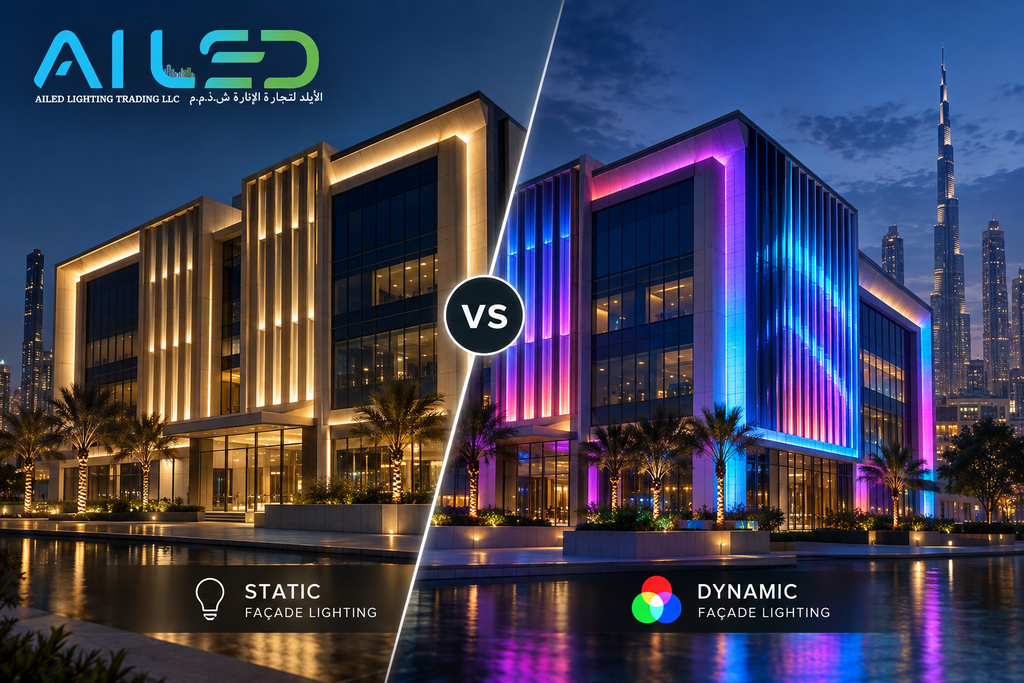
What Is Static Façade Lighting?
Static façade lighting creates a relatively fixed nighttime appearance for a building.
The fixtures normally operate with predetermined colours, intensities, beam angles, and switching schedules. Although dimming or basic scheduling can still be incorporated, the overall visual composition generally remains consistent from night to night.
For example, warm white linear lighting may continuously highlight the vertical lines of a hotel, while narrow-beam fixtures illuminate columns or architectural details.
Static lighting can be suitable when the architectural concept requires a refined and consistent appearance rather than frequent visual changes.
Common applications include:
Residential developments
Villas
Office buildings
Hotels
Architectural heritage projects
Low-rise commercial properties
Buildings requiring a consistent brand appearance
A carefully planned static system can create an elegant nighttime identity without requiring complex programming.
What Is Dynamic Facade Lighting?
Dynamic facade lighting is an architectural lighting approach in which the appearance of a façade can change over time.
Instead of displaying one fixed lighting scene, a dynamic system can control variables such as colour, intensity, transitions, sequences, zones, and timing.
Depending on the system design, individual fixtures or groups of fixtures can be controlled independently. This makes it possible to create subtle changes in brightness or more sophisticated animated effects across a large architectural surface.
Modern control technologies such as DMX can coordinate multiple fixtures and lighting zones to create programmed scenes.
For example, a building could display a calm white appearance during normal evenings and use carefully programmed colour scenes for events or special occasions.
This flexibility is one reason modern dynamic facade lighting Dubai projects are often considered for landmark buildings, hospitality destinations, entertainment venues, shopping developments, and other architecture where nighttime presentation is important.
Static vs Dynamic Facade Lighting
Although both approaches illuminate architecture, their design objectives and technical requirements can be significantly different.
Feature Static Façade Lighting Dynamic Façade Lighting
Visual appearance Primarily fixed Changeable
Colour options Usually fixed or limited Multiple colours and scenes possible
Programming Basic Advanced programming possible
Control Simple switching/dimming Individual or grouped control
Animation Limited Possible
Installation complexity Generally lower Can be higher
Maintenance requirements Usually simpler Depends on system complexity
Best suited for Consistent architectural identity Flexible or expressive nighttime identity
The correct approach depends on the architecture and project objectives rather than simply choosing the system with more features.
- Visual Flexibility
One of the clearest differences is flexibility.
Static façade lighting is designed around a predetermined visual composition. Once the fixtures, colour temperatures, intensities, and aiming positions are established, the appearance generally remains consistent.
Dynamic facade lighting, on the other hand, allows designers to create multiple lighting scenes.
A single building might use different programmed settings for regular evenings, weekends, events, seasonal periods, or specific architectural presentations.
The system can also be designed for subtle movement rather than dramatic animation. Slow intensity transitions or gentle colour changes can create a sophisticated appearance without overwhelming the architecture.
- Architectural Identity
Lighting should support architecture rather than compete with it.
For buildings with clean geometry and minimal architectural lines, a static system may provide the visual consistency required to preserve the original design language.
Dynamic systems can be useful where the building is intended to have a more adaptable nighttime identity.
A façade may appear calm and understated on a normal evening while taking on a different visual character for a major event.
The key is creating a facade lighting design that respects proportions, materials, glazing, surrounding properties, viewing distances, and the architect’s original concept.
- Lighting Control
Static systems usually require comparatively straightforward control.
Timers, photocells, dimming systems, or building management integrations can determine when the façade lighting switches on, switches off, or operates at reduced intensity.
Dynamic systems generally require more sophisticated controls.
Depending on the project, the system may include:
DMX controllers
Lighting control software
Addressable fixtures
Scene programming
Network components
Signal distribution
Scheduled sequences
Centralised control interfaces
Good control design is particularly important for projects involving hundreds of fixtures.
Every fixture must respond correctly to commands for the intended visual effect to remain coordinated.
- Facade Light Installation
The complexity of facade light installation varies significantly according to the building.
A static installation may involve fewer control components because fixtures can often be arranged into relatively simple circuits or lighting zones.
Dynamic systems may require additional cabling, controllers, addressing, data distribution, programming, testing, and commissioning.
Installation planning should therefore begin during the design stage rather than after fixture selection.
Designers and contractors may need to consider cable routes, mounting details, fixture accessibility, waterproof connections, control-panel locations, maintenance access, power supplies, and communication between different lighting zones.
Poor installation planning can affect both the appearance and reliability of the final system.
- Initial Project Cost
Budget is another important consideration.
Static façade lighting will often require a simpler control architecture, which may reduce certain equipment, installation, programming, and commissioning requirements.
Dynamic lighting can involve additional investment in control equipment, addressable fixtures, software, data infrastructure, programming, and specialist commissioning.
However, cost should be evaluated against the actual objectives of the building.
Installing advanced dynamic capabilities that will rarely be usedmay add unnecessary complexity. Conversely, selecting a basic static system for a building that requires changing scenes can restrict future creative possibilities.
A suitable facade lighting company should therefore understand the project’s operational objectives before proposing a system.
- Maintenance
Maintenance requirements should be considered before fixtures are installed.
Static systems typically have fewer control elements and may therefore be simpler to diagnose.
Dynamic systems can contain additional components, including controllers, drivers, network equipment, data connections, and software configurations.
This does not automatically mean that dynamic systems are difficult to maintain. A properly documented system with accessible equipment and organised control architecture can simplify troubleshooting.
Fixture quality is also important, particularly in outdoor environments where products may be exposed to dust, heat, humidity, rain, and temperature changes.
- Energy Management
The energy performance of façade lighting depends on several factors, including fixture wattage, quantity, operating hours, intensity, control strategy, and programming.
Dynamic systems can provide additional control over how and when lighting operates.
For example, a building might operate at higher brightness during peak evening hours before automatically reducing intensity later at night.
Static systems can also incorporate timers and dimming controls.
Therefore, neither approach should automatically be considered more energy efficient. Energy performance depends largely on the overall design and operating strategy.
Types of Facade Lighting
Understanding the main types of facade lighting can help determine which techniques work with static or dynamic systems.
Grazing
Fixtures are installed close to a surface so that light emphasises textures, relief, stone, brickwork, or other architectural materials.
Wall Washing
Light is distributed more evenly across a façade surface to create consistent illumination.
Linear Lighting
Linear fixtures can follow architectural lines, edges, frames, fins, or structural elements.
Accent Lighting
Selected architectural details are highlighted to create visual hierarchy.
Media Façade Lighting
Individually controlled lighting elements can create patterns, movement, graphics, or large-scale visual sequences.
Colour-Changing RGB/RGBW Lighting
RGB or RGBW fixtures allow designers to create multiple colours and programmable scenes. This technique is commonly associated with dynamic facade lighting.
A single project can combine several techniques to create depth and visual balance.
Where Is Static Façade Lighting Suitable?
Static lighting can be a practical option when consistency is the main design objective.
It may work particularly well for residential developments, villas, offices, luxury properties, hospitality buildings, and architectural projects where a permanent nighttime appearance is preferred.
It can also be suitable when simplified operation and control are priorities.
The goal should still be to carefully consider fixture placement, beam angles, brightness, glare, colour temperature, and architectural integration.
Static does not mean visually basic. A well-designed static system can create a highly sophisticated architectural identity.
Where Is Dynamic Facade Lighting Suitable?
Dynamic facade lighting can be considered when a building needs visual flexibility or programmable nighttime scenes.
Potential applications include:
Landmark towers
Shopping malls
Hotels and resorts
Entertainment destinations
Cultural venues
Sports facilities
Mixed-use developments
Commercial destinations
Event-oriented architecture
For these projects, the façade can become an active part of the building’s nighttime identity.
However, movement and colour should be carefully controlled. Excessive brightness or animation can distract from architectural details and may contribute to unwanted light spill.
Dynamic Facade Lighting in Dubai
Dubai’s architecture includes hotels, towers, retail destinations, residential developments, entertainment venues, and mixed-use projects with very different nighttime identities.
This variety creates opportunities for both static and dynamic architectural lighting.
For developers exploring dynamic facade lighting Dubai, decisions should be based on more than visual impact alone. Environmental conditions, fixture durability, glare control, viewing distance, control infrastructure, access for maintenance, energy consumption, and architectural integration should all be considered.
Rather than simply searching for the best dynamic facade lighting Dubai, project teams can evaluate whether a proposed system matches the building’s specific architecture and operational needs.
The most visually complex solution is not automatically the most appropriate one.
Choosing Between Facade Lighting Companies in UAE
When comparing facade lighting companies in UAE, it can be useful to look beyond the fixture catalogue.
Façade lighting is a combination of creative design, engineering, product selection, control, installation, testing, programming, and long-term maintenance planning.
Important factors to discuss with a lighting provider include architectural objectives, fixture specifications, photometric requirements, control protocols, outdoor protection, glare management, electrical planning, commissioning, and technical support.
For dynamic projects, programming capability is particularly important because the final appearance depends not only on the hardware but also on how the system is configured.
The Importance of Facade Lighting Design
Successful facade lighting design begins with understanding the building.
Before deciding between static and dynamic lighting, designers should study:
Architectural geometry
Façade materials
Surface colours
Glass and reflective elements
Important viewing angles
Nearby buildings
Landscape elements
Fixture mounting opportunities
Desired nighttime identity
Maintenance accessibility
Control requirements
Lighting calculations, mock-ups, visualisations, and on-site testing can then help refine the concept.
This process reduces the risk of excessive brightness, uneven illumination, visible fixtures, glare, poor colour consistency, or unwanted shadows.
Can Static and Dynamic Lighting Be Combined?
Yes.
A hybrid approach can combine the visual stability of static architectural lighting with the flexibility of dynamic elements.
For example, a building’s main architectural structure could remain illuminated in a consistent warm or neutral white, while selected fins, crowns, entrances, or vertical elements use programmable RGBW lighting.
During normal operation, the entire building can maintain a restrained appearance. For specific occasions, the dynamic zones can introduce additional visual effects.
This approach allows dynamic technology to enhance selected architectural features without turning every part of the façade into an animated surface.
How AILED Approaches Facade Lighting
AILED Lighting Trading LLC | Facade Lighting focuses on architectural lighting solutions for different project requirements across Dubai and the UAE.
The appropriate solution can involve static illumination, dynamic controls, or a combination of both depending on the architectural concept and technical requirements.
For projects involving dynamic facade lighting, careful coordination between fixtures, controllers, installation details, electrical systems, and programming is essential.
The objective is not simply to add more light to a building. It is to use light strategically to reveal architectural character after dark.
Static or Dynamic: Which Should You Choose?
There is no universal answer.
Choose static façade lighting when the project requires a consistent nighttime appearance, relatively straightforward control, and limited changes to lighting scenes.
Consider dynamic facade lighting when the project requires programmable colours, adjustable scenes, coordinated transitions, event-based lighting, or greater flexibility in how the building appears at night.
For some projects, a combination of both can provide the appropriate balance.
The decision should ultimately be based on architecture, project purpose, budget, technical infrastructure, maintenance requirements, surrounding environment, and desired nighttime identity.
Conclusion
Static and dynamic façade lighting can both transform how architecture is experienced after sunset, but they serve different objectives.
Static systems offer consistency and straightforward operation, while dynamic facade lighting provides greater control over colour, intensity, timing, transitions, and programmed scenes.
For modern buildings in Dubai and the UAE, the right approach should be determined by architectural requirements rather than visual trends alone.
With thoughtful facade lighting design, appropriate fixture selection, professional facade light installation, and well-planned controls, lighting can become an integrated part of the architecture instead of simply an addition to it.
AILED Lighting Trading LLC works with architectural façade lighting concepts and solutions designed around the individual requirements of each project.
Frequently Asked Questions
- What is dynamic facade lighting?
Dynamic facade lighting is a system that allows a building’s exterior lighting to change in colour, brightness, timing, patterns, or programmed scenes.
- Is dynamic façade lighting better than static lighting?
Neither is universally better. Static lighting suits buildings requiring a consistent appearance, while dynamic lighting is useful when programmable scenes and visual flexibility are required.
- What are the main types of facade lighting?
Common types include wall washing, grazing, accent lighting, linear lighting, colour-changing RGB/RGBW systems, and media façade lighting.
- Can dynamic facade lighting use DMX control?
Yes. DMX is commonly used to coordinate compatible lighting fixtures and create programmed scenes, colour changes, dimming, and sequences.
- Can static and dynamic façade lighting be used together?
Yes. A hybrid design can use static illumination for primary architectural elements and dynamic lighting for selected features requiring programmable effects.